

KöMaL Problems in Physics, September 2026
Please read the rules of the competition.
Show/hide problems of signs:
 |
Problems with sign 'M'Deadline expired on October 15, 2026. |
M. 451. Fix a vertical rod on a sunlit horizontal surface, and investigate the motion of its shadow. Determine the trajectory of the endpoint of the shadow and its instantaneous speed at a given position.
(6 pont)
 |
Problems with sign 'G'Deadline expired on October 15, 2026. |
G. 929. In the second half of the last century, London’s famous large red double-decker buses operated with an open rear platform, which allowed passengers to board and alight while the bus was moving. Suppose that such a bus is travelling at a constant speed of 18 km/h, and a person wants to catch up with it. From at most what distance can he start and still catch the bus, if he starts from rest, can initially increase his speed by 1 m/s every second up to 8 m/s, but after 12 s becomes tired and slows down at the same rate as his previous acceleration until reaching 4 m/s?
(4 pont)
G. 930. A straight ruler of length 30 cm and mass 30 g is placed on a horizontal table so that only the section from 0 to 5 cm rests on the table; that is, the section from 5 cm to 30 cm overhangs the edge. What downward force must be applied to the ruler at the 0 cm mark in order to keep it at rest, if small weights of 10 g, 20 g, and 30 g are placed on the ruler at the 10 cm, 20 cm, and 30 cm marks, respectively? (Neglect the bending of the ruler.)
(3 pont)
G. 931. Since the Earth's core is extremely hot, a significant amount of heat flows from the Earth's interior towards the surface. Measurements show that the total heat flow through the Earth's crust near the surface is approximately 47 TW (terawatts). Compare this heat flow with the thermal power received by the Earth from the Sun. What is the ratio of the two heat flows?
(3 pont)
G. 932. Light rays emitted from the focal point of a diverging lens emerge from the lens as if they originated from a point at a distance \(\displaystyle \alpha|f|\) from the lens. Determine the value of \(\displaystyle \alpha\).
(3 pont)
 |
Problems with sign 'P'Deadline expired on October 15, 2026. |
P. 5742. According to a rather eccentric idea, the first adventure park in Antarctica would feature a gigantic ice structure in the form of a downward-opening paraboloid of revolution with a vertical axis of symmetry. From a small ``escape room" located at the focus, many narrow, straight tunnels would lead to the outside, along any of which visitors released from rest could slide without friction. Which tunnel should a visitor choose in order to escape from the ice block in the shortest possible time?
(4 pont)
P. 5743. The point-like balls of masses \(\displaystyle M\) and \(\displaystyle m_1\) attached to the ends of the equal-length pendulums shown in the figure are just touching when the strings are vertical. The pendulum carrying the mass \(\displaystyle M\) is displaced through an angle \(\displaystyle 0<\alpha\leq 90^\circ\) from the vertical and then released from rest. After the perfectly elastic collision of the two balls, the maximum angular displacement of the pendulum of mass \(\displaystyle M\) from the vertical is \(\displaystyle \Phi_1\). The ball of mass \(\displaystyle m_1\) is then replaced by another ball of mass \(\displaystyle m_2\), and the experiment is repeated under identical conditions. In this case, the maximum angular displacement of the pendulum of mass \(\displaystyle M\) from the vertical is \(\displaystyle \Phi_2\).
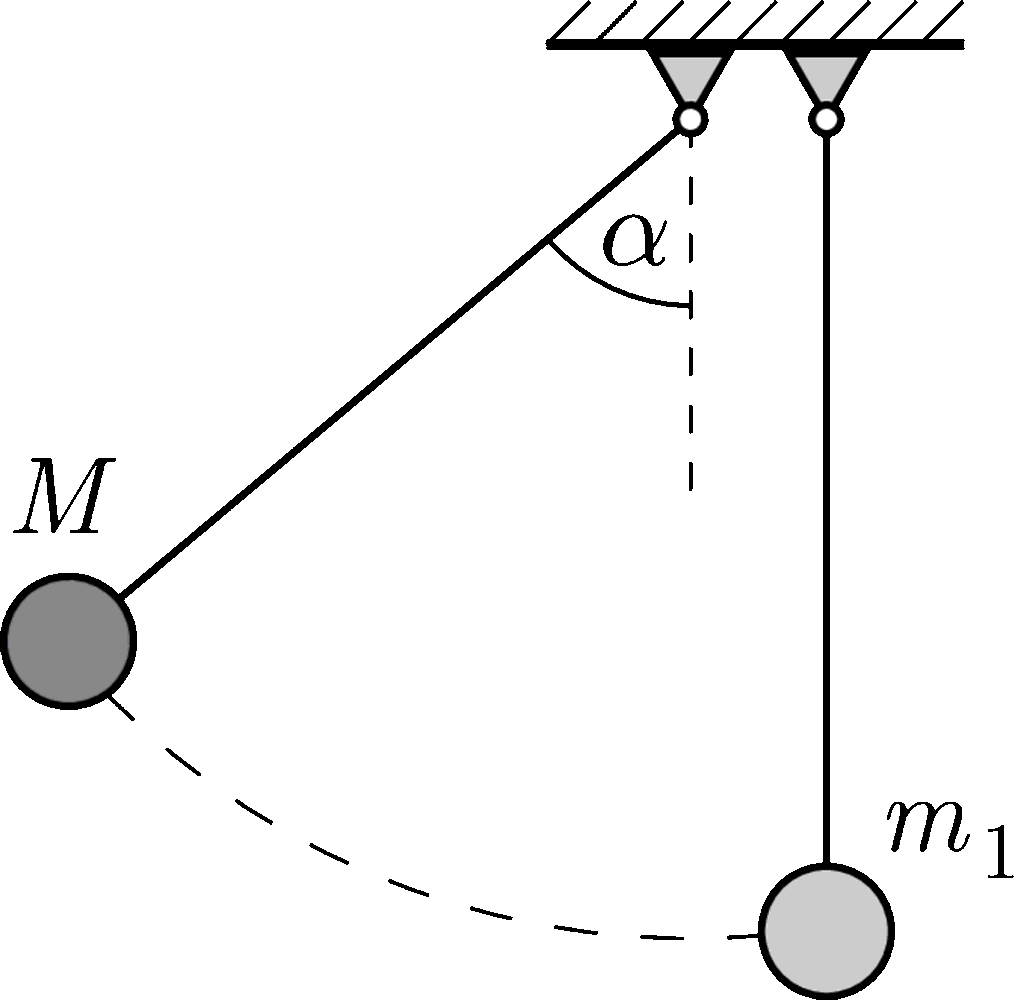
What is the relationship between \(\displaystyle \Phi_1\) and \(\displaystyle \Phi_2\) if \(\displaystyle M\) is the geometric mean of \(\displaystyle m_1\) and \(\displaystyle m_2\)?
(4 pont)
P. 5744. We have two straight metal rods with the same cross-sectional area, one of which is twice as long as the other. The rods are soldered together at one end to form a longer straight rod whose centre of mass divides the total length in the golden ratio. What is the ratio of the densities of the two metals?
(4 pont)
P. 5745. Estimate the order of magnitude of the ratio of the Earth’s orbital angular momentum to its rotational angular momentum.
(4 pont)
P. 5746. A small spacecraft orbits a star on a trajectory of eccentricity \(\displaystyle e\), with speed \(\displaystyle v(t)\). By what factor is the energy gained by the spacecraft greater if it makes a small tangential velocity increase \(\displaystyle \Delta v\ll v(t)\) at the pericentre rather than at the apocentre?
(5 pont)
P. 5747. A body of mass \(\displaystyle m\) is suspended from a long elastic string with spring constant \(\displaystyle D\), causing the string to extend by \(\displaystyle \Delta\ell_0\). Starting from the equilibrium position, the body is displaced vertically so that, in the first case, the total extension of the string is \(\displaystyle 2\Delta\ell_0\), and, in the second case, it is \(\displaystyle 3\Delta\ell_0\). Calculate the period of each motion, and sketch the corresponding velocity-time graphs.
(5 pont)
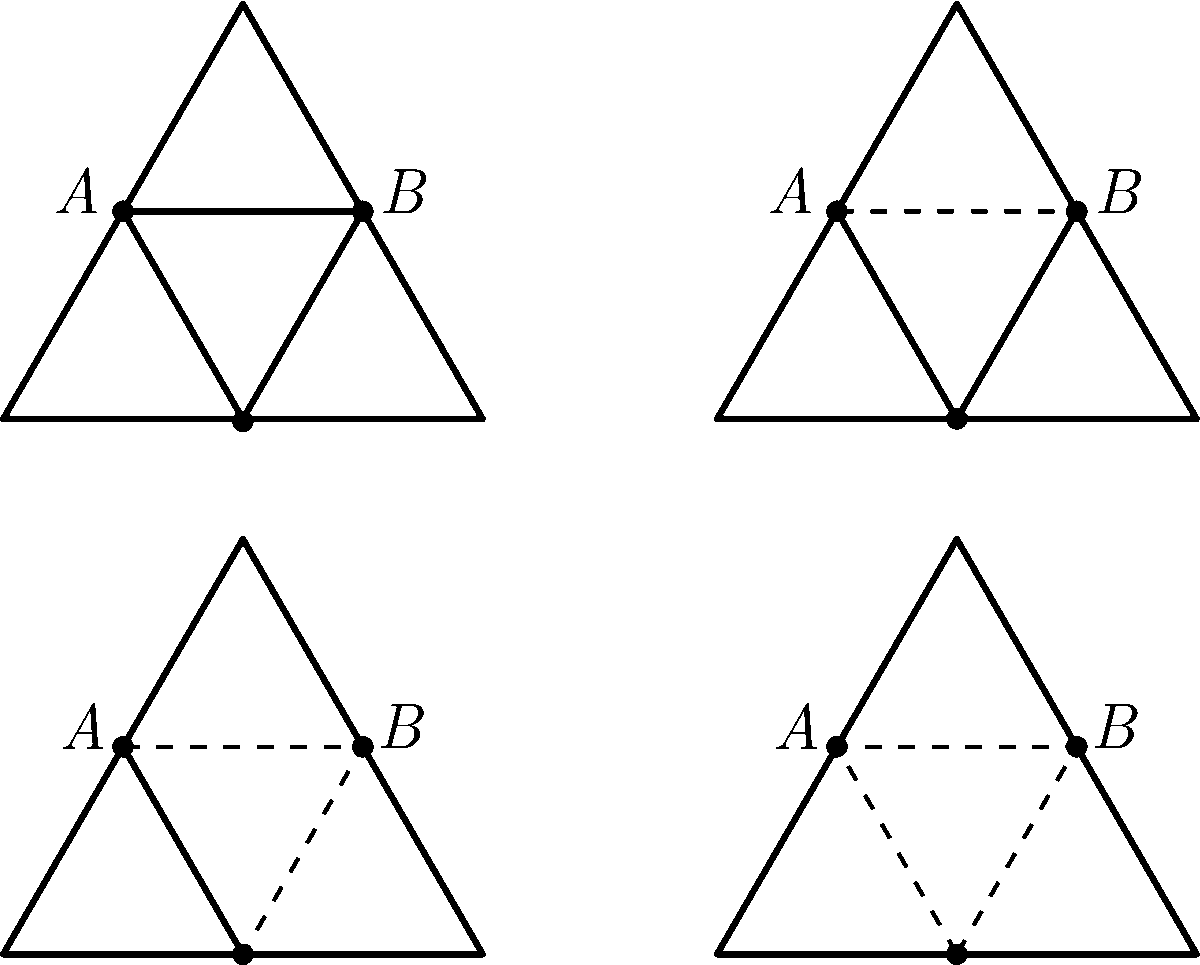
P. 5748. The frame shown in the upper left figure is made of wire of uniform cross section. In the successive cases, the edges indicated by dashed lines are removed. In each of the four cases, the same DC voltage is applied between the points \(\displaystyle A\) and \(\displaystyle B\). Calculate the ratio of the four thermal powers.
(4 pont)
P. 5749. The frame shown in the upper left figure is made of wire of uniform cross section. In the successive cases, the edges indicated by dashed lines are removed. In each of the four cases, the same DC voltage is applied between the points \(\displaystyle A\) and \(\displaystyle B\). Calculate the ratio of the four thermal powers.
(4 pont)
P. 5750. A current of magnitude \(\displaystyle I\) is drawn from one end of a sufficiently long, straight, relatively thick copper wire of radius \(\displaystyle R\), and is returned to the wire through a very thin wire filament at a surface point \(\displaystyle A\) located at a distance \(\displaystyle L\gg R\) from that end (see the figure).
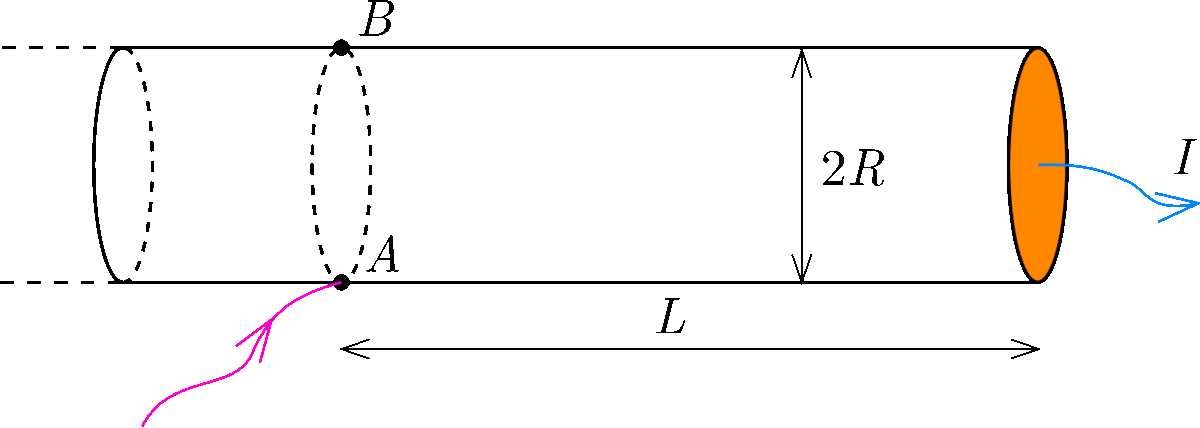
What are the magnitude and direction of the current density in the immediate vicinity of the point \(\displaystyle B\) opposite to \(\displaystyle A\)?
(6 pont)
Upload your solutions above.