

KöMaL Problems in Mathematics, September 2026
Please read the rules of the competition.
Show/hide problems of signs:
 |
Problems with sign 'K'Deadline expired on October 12, 2026. |
K. 909. In the game of `Six Bang', the players form a circle, and the first player says 1, and then each subsequent player says the next integer number, or a certain number of `Bangs'. Bangs have to be said when at least one of the conditions below is satisfied, and the number of Bangs equals the number of conditions satisfied. I. Is a multiple of 6. II. Contains a digit that is 6. III. The sum of its digits is a multiple of 6. IV. The product of its digits is a multiple of 6. For single digit numbers both the sum and the product of the digits are equal to the number itself. a) Show two numbers, instead of which `BangBang' should be said. b) A player had to say `BangBangBang' instead of a number. Which condition was not satisfied? Find all possibilities.
(5 pont)
solution (in Hungarian), statistics
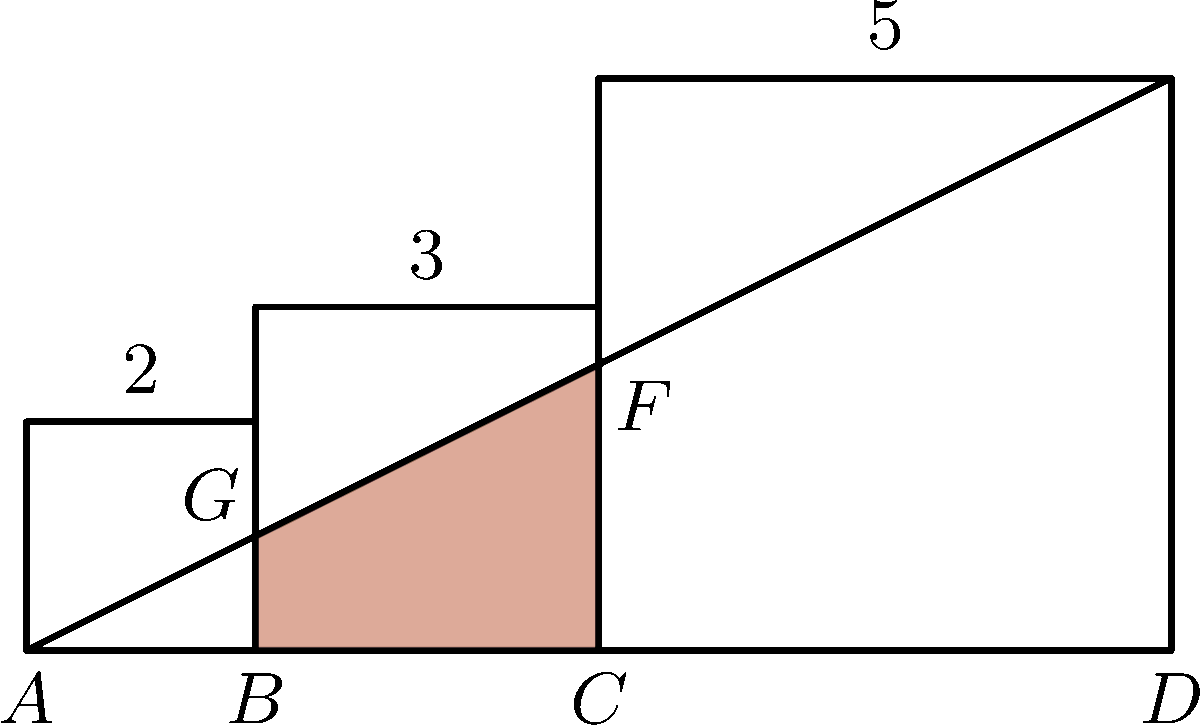
K. 910. Three squares of side lengths \(\displaystyle 2\), \(\displaystyle 3\) and \(\displaystyle 5\) are drawn next to each other according to the diagram. Find the area of quadrilateral \(\displaystyle BCFG\).
(5 pont)
K. 911. Is it possible to divide an equilateral triangle into 99, 100 and 101 isosceles triangles such that not all triangles in the division are equilateral?
(5 pont)
 |
Problems with sign 'K/C'Deadline expired on October 12, 2026. |
K/C. 912. On 7-segment displays, digits are created from small hexagons. 0 is created from six hexagons, 1 is created from two hexagons, 2 is created from five hexagons and so on (see the diagram).

Our old digital clock displays time with at most four such digits, and the displayed time changes every minute. For how many minutes is such a time displayed (between 0:00 and 23:59) for which 20 minutes later the time is created from the same number of hexagons as the original time?
(5 pont)
K/C. 913. Let \(\displaystyle A\), \(\displaystyle B\) and \(\displaystyle C\) be different positive digits. What should numbers \(\displaystyle \overline{ABC}\), \(\displaystyle \overline{BCA}\) and \(\displaystyle \overline{CAB}\) be to maximize their greatest common divisor?
Proposed by: Péter Frankl, Tokyo
(5 pont)
 |
Problems with sign 'C'Deadline expired on October 12, 2026. |
C. 1908. 2026 is a four-digit, positive number such that all its digits are even and exactly two of them are equal. How many such four-digit positive integer numbers are there?
Proposed by: Katalin Abigél Kozma, Győr
(5 pont)
C. 1909. Let \(\displaystyle D\) denote the midpoint of arc \(\displaystyle BC\) not containing point \(\displaystyle A\) on the circumcircle of equilateral triangle \(\displaystyle ABC\). Let \(\displaystyle E\) denote the midpoint of line segment \(\displaystyle AC\), and let \(\displaystyle F\) denote the midpoint of line segment \(\displaystyle BC\). a) Find the magnitude of angle \(\displaystyle \angle EBD\) b) Let \(\displaystyle F'\) denote the reflection of \(\displaystyle F\) across \(\displaystyle E\). Prove the circle with center \(\displaystyle F'\) and radius \(\displaystyle F'C\) passes through the midpoint of side \(\displaystyle AB\).
Based on a greek competition problem
(5 pont)
C. 1910. Bogi likes to play with pebbles which she calls gems. Currently she has 4052 gems, and she labeled them with numbers 1, 2, 3, ..., 4052. She wants to place her gems in a red and a blue box such that for every \(\displaystyle k=1\), 2, 3, ..., 2026 gems with label \(\displaystyle k\) and \(\displaystyle 2k\) should be in different boxes. How many ways can Bogi distribute her gems?
German competition problem
(5 pont)
C. 1911. Let \(\displaystyle F\) denote the midpoint of the side \(\displaystyle BC\) of triangle \(\displaystyle ABC\). We construct isosceles right triangles \(\displaystyle BAD\) and \(\displaystyle ACE\) on sides \(\displaystyle AB\) and \(\displaystyle AC\) pointing outwards such that \(\displaystyle AB\) and \(\displaystyle AC\) are the hypotenuses. Prove that \(\displaystyle EDF\) is an isosceles right triangle.
Irish competition problem
(5 pont)
C. 1912. Let \(\displaystyle a_1, a_2, \ldots a_{10}\) be positive, not necessarily distinct numbers such that their sum is 95. Prove that \(\displaystyle a_1^2+a_2^2+a_3^2+a_4^2+a_5^2+a_6^2+a_7^2+a_8^2+a_9^2+a_{10}^2 \geq 905\). When does the equality hold?
Scottish competition problem
(5 pont)
 |
Problems with sign 'B'Deadline expired on October 12, 2026. |
B. 5542. A group of 13 people wants to get to a city that is 50 km away. Unfortunately, public transport is not available nearby, but they can walk at a speed of 5 km/h, and they also have a five-seat car that can travel at a speed of 80 km/h. Is it possible for the group to get to the other city in 2 and a half hours time?
Proposed by: Bálint Hujter, Budapest
(3 pont)
B. 5543. Let \(\displaystyle e\) and \(\displaystyle f\) be the opposite side of a rectangular pool table, and let \(\displaystyle A\) and \(\displaystyle B\) be two interior points. Prove that if a billiard ball travels from \(\displaystyle A\) to be \(\displaystyle B\) such that it bounces twice on side \(\displaystyle e\) and bounces twice on side \(\displaystyle f\) (and does not bounce on the other two sides), then it will travel through the midpoint of line segment \(\displaystyle AB\).
Proposed by: Zoltán Gyenes and Bálint Hujter, Budapest
(3 pont)
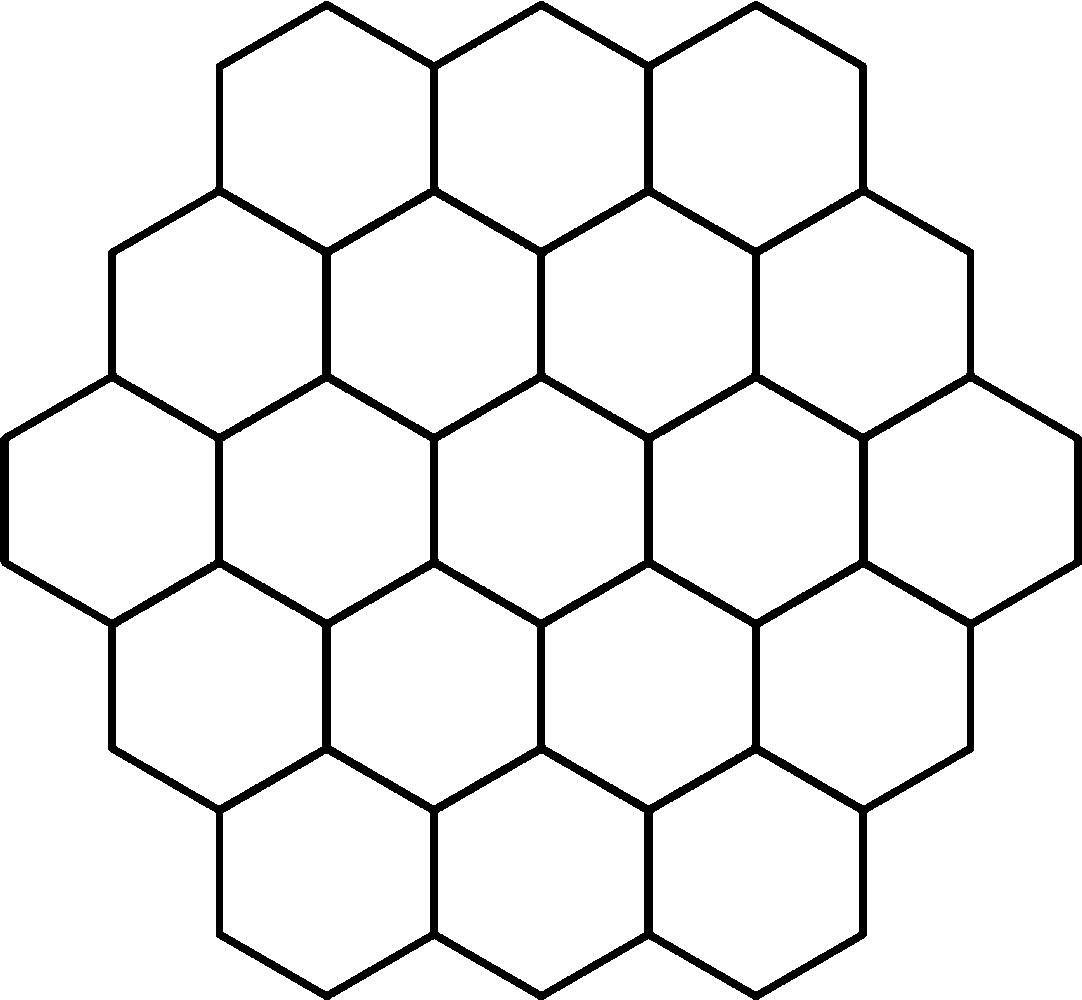
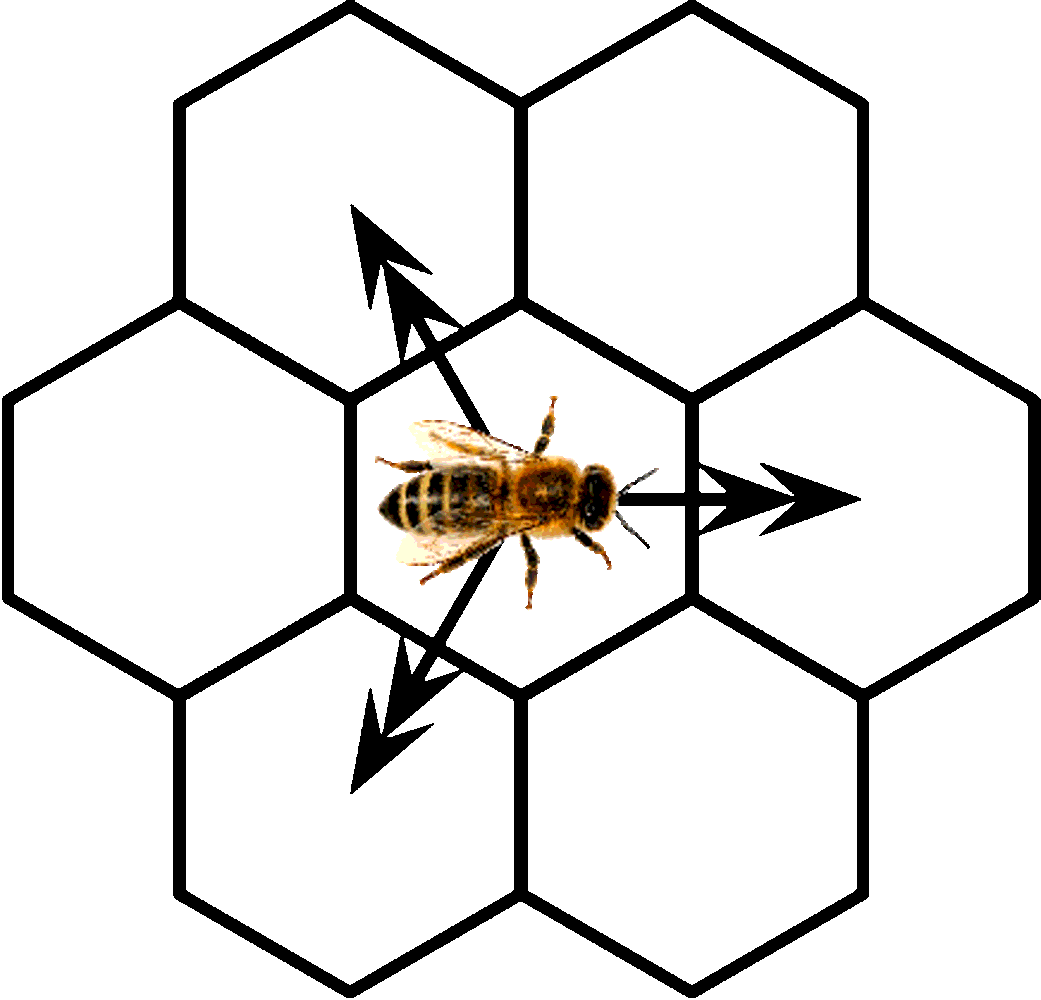
B. 5544. A bee is dancing on the cells in the diagram. When it passes from a cell to another one, then either it continues its path in a straight line, or makes a turn of \(\displaystyle 120^\circ\), as shown in the diagram. From which initial cells can the bee visit all nineteen cells exactly once?
Proposed by: Szilveszter Kocsis, Budapest
(4 pont)
B. 5545. The sides of an acute triangle have lengths \(\displaystyle a\), \(\displaystyle b\) and \(\displaystyle c\). The lengths of the line segments connecting the triangle's isogonal point to its vertices are \(\displaystyle x\), \(\displaystyle y\) and \(\displaystyle z\). Prove that \(\displaystyle a^2\), \(\displaystyle b^2\) and \(\displaystyle c^2\) form an arithmetic sequence (in some order) if and only if \(\displaystyle x\), \(\displaystyle y\) and \(\displaystyle z\) form an arithmetic sequence in some order.
Proposed by: József Pázmándi and Dániel Lenger, Budapest
(4 pont)
B. 5546. For positive integers \(\displaystyle a\), \(\displaystyle b\), \(\displaystyle c\) the values of expressions \(\displaystyle \frac{a}{b}+\frac{b}{c}+\frac{c}{a}\) and \(\displaystyle \frac{a}{c}+\frac{c}{b}+\frac{b}{a}\) are also integers. Prove that \(\displaystyle a=b=c\).
Proposed by: Gábor Holló, Budapest
(5 pont)
B. 5547. Prove that if the side lengths of a non-equilateral triangle satisfy \(\displaystyle b^2+c^2=2a^2\), the foot of the perpendicular from vertex \(\displaystyle A\) to the Euler line bisects the orthogonal projection of \(\displaystyle BC\) onto the Euler line.
Proposed by: Zsófia Keresztély, Cambridge, Massachusetts
(5 pont)
B. 5548. Solve the following equation on the set of real numbers: \(\displaystyle \bigl(\frac{x}{\sqrt{2y-3}}\bigr)^3+\bigl(\frac{y}{\sqrt{2x-3}}\bigr)^3=6\sqrt{3}\).
Proposed by: Mihály Bencze, Brasov
(6 pont)
B. 5549. Scalene triangle \(\displaystyle ABC\) is given. Let \(\displaystyle O\) denote the circumcenter of the triangle. Let \(\displaystyle P\) denote the intersection point, other than \(\displaystyle O\), of the circle with diameter \(\displaystyle AO\) and circle \(\displaystyle BCO\). Similarly, let \(\displaystyle Q\) denote the second intersection point of the circle with diameter \(\displaystyle BO\) and circle \(\displaystyle CAO\). Finally, let \(\displaystyle R\) denote the second intersection point of the circle with diameter \(\displaystyle CO\) and circle \(\displaystyle ABO\). Prove that points \(\displaystyle P\), \(\displaystyle Q\), \(\displaystyle R\) and \(\displaystyle O\) are concyclic.
Proposed by: Gábor Holló, Budapest
(6 pont)
 |
Problems with sign 'A'Deadline expired on October 12, 2026. |
A. 938. Prove that all divisors of the positive integer \(\displaystyle 1\underbrace{000\ldots00}_{2026}\underbrace{999\ldots99}_{2026}\) (written in base 10) end in a digit 1 or 9 (also in base 10).
Proposed by: Géza Kós, Budapest
(7 pont)
A. 939. In the acute and scalene triangle \(\displaystyle ABC\) let \(\displaystyle A_1\), \(\displaystyle B_1\) and \(\displaystyle C_1\) denote the feet of altitudes from \(\displaystyle A\), \(\displaystyle B\) and \(\displaystyle C\), respectively. Let \(\displaystyle A_2\), \(\displaystyle B_2\) and \(\displaystyle C_2\) denote the intersection of the internal angle bisectors from \(\displaystyle A\), \(\displaystyle B\) and \(\displaystyle C\), respectively, with the opposite sides. Let \(\displaystyle X_1\) denote the point of intersection of lines \(\displaystyle A_1B_1\) and \(\displaystyle A_2C_2\), and let \(\displaystyle X_2\) denote the point of intersection of lines \(\displaystyle A_1C_1\) and \(\displaystyle A_2B_2\). Similarly, let \(\displaystyle Y_1\) denote the point of intersection of lines \(\displaystyle B_1C_1\) and \(\displaystyle B_2A_2\) and \(\displaystyle Y_2\) denote the point of intersection of lines \(\displaystyle B_1A_1\) and \(\displaystyle B_2C_2\), let \(\displaystyle Z_1\) denote the point of intersection of lines \(\displaystyle C_1A_1\) and \(\displaystyle C_2B_2\), and finally let \(\displaystyle Z_2\) denote the point of intersection of lines \(\displaystyle C_1B_1\) and \(\displaystyle C_2A_2\). Assume that all these points exist and are distinct. Prove that points \(\displaystyle A\), \(\displaystyle X_1\), \(\displaystyle X_2\), points \(\displaystyle B\), \(\displaystyle Y_1\), \(\displaystyle Y_2\) and points \(\displaystyle C\), \(\displaystyle Z_1\) and \(\displaystyle Z_2\) are collinear, and these three lines are concurrent.
Proposed by: Ágoston Török, London
(7 pont)
A. 940. Let \(\displaystyle p\) be a prime number and let \(\displaystyle k\) be an integer with \(\displaystyle 1\le k\le p\). Suppose that \(\displaystyle f(x)\) is a polynomial with integer coefficients such that its value at every integer point gives a remainder of \(\displaystyle 0\) or \(\displaystyle 1\) when divided by \(\displaystyle p^k\), and both cases occur. Show that the degree of \(\displaystyle f\) is at least \(\displaystyle k(p-1)\).
Proposed by: Géza Kós, Budapest
(7 pont)
Upload your solutions above.