

KöMaL Problems in Mathematics, October 2026
Please read the rules of the competition.
Show/hide problems of signs:
 |
Problems with sign 'K'Deadline expired on November 10, 2026. |
K. 914. A \(\displaystyle 4\times 4\times 4\) cube is built from 64 unit cubes. Some of the unit cubes are transparent, and some are not. The completed large cube is illuminated alternately from three mutually perpendicular directions: from the front, from the side and from above. In the figure, the shadows cast by the cube caused by the light from the different directions are depicted.
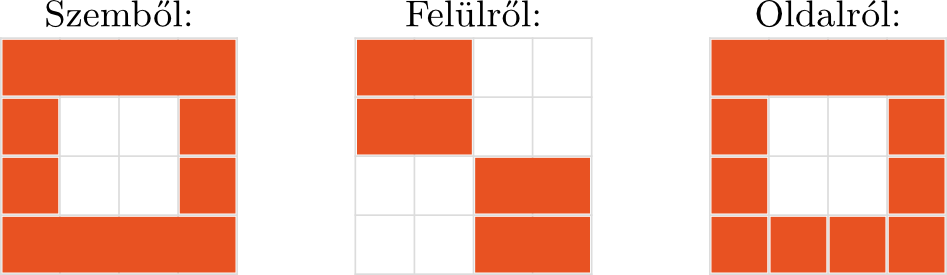
Find the number of the opaque unit cubes if we've used the smallest possible number of them.
Proposed by Dániel Varga, Budapest
(5 pont)
K. 915. Air traffic controllers in Alturia see the runway on their computer screens as shown in the figure. The entire runway is a \(\displaystyle (3 \times 10)\) grid, meaning it consists of 30 sectors. A signal light shines at all 4 corners of each sector to assist with takeoff and landing. The signal lights light up as follows: at 7:00 PM, those whose first coordinate is 11 are switched on simultaneously, then one second later, those whose first coordinate is 10 are switched on simultaneously. And so on, one second later they simultaneously switch on those with coordinates 9, 8, \(\displaystyle \ldots\)
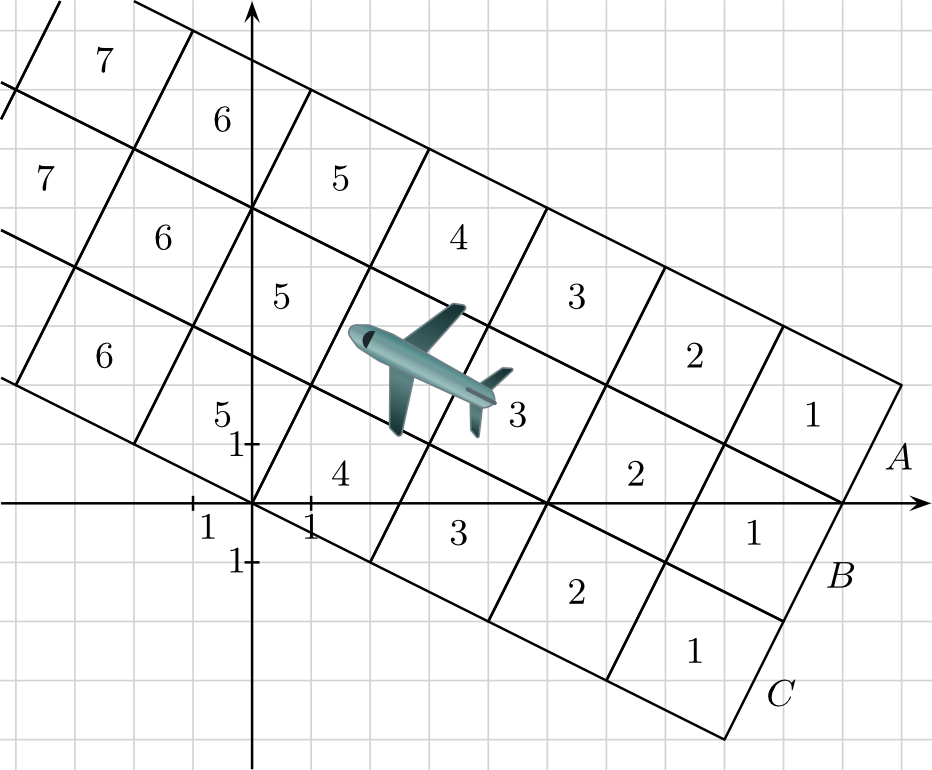
The lights are turned off based on the second coordinates: at 7:00 AM those whose second coordinate is \(\displaystyle -4\) are turned off simultaneously, then one second later those with \(\displaystyle {-3}\), \(\displaystyle {-2}\), \(\displaystyle {-1}\), 0, 1, \(\displaystyle \ldots\).
a) How many of the lights are shining for exactly 12 hours? Which are these?
b) Which light shines for the longest time? Which light shines for the shortest time?
(5 pont)
K. 916. In a football league, 18 teams play a round-robin tournament (every team plays against every other team exactly once). The tournament is organized in rounds, meaning that in each round, every team plays against one of the other teams. Prove that after the eighth round there will be three teams such that none of these teams has played with the other two teams.
(5 pont)
 |
Problems with sign 'K/C'Deadline expired on November 10, 2026. |
K/C. 917. In the game called ``Six-Boom'', the players stand in a circle. The first player says ``1'', and after that, the next player in turn either says the next whole number, or must say a certain number of ``booms'' instead of saying the number. A certain number of booms must be said if any of the conditions below are met for the next number in sequence, and in that case, as many ``booms'' must be said as the number of conditions met.
- Multiple of 6.
- Contains a digit 6.
- The sum of the digits is a multiple of 6.
- The product of the digits is a multiple of 6.
For the single digit numbers the sum and the product of the digits are both equal to the number. Is it possible that
a) at least 100
b) exactly 11
c) exactly 10
times the numbers are not said, but a certain number of booms instead? (If the numbers are not said exactly \(\displaystyle n\) times consecutively, it means that the number right before the \(\displaystyle n\) numbers and the number are right after the \(\displaystyle n\) numbers are said.)
(5 pont)
K/C. 918. We have written all the integers from \(\displaystyle {-1012}\) to \(\displaystyle 1012\) on 2025 pieces of paper, and we've put these pieces of paper randomly distributed in a box. Somebody takes 506 pieces of paper from the box randomly. Prove that it is possible to take another 507 pieces of paper from the box such that the sum of the numbers on the \(\displaystyle 506+507=1013\) pieces of paper is 0.
(5 pont)
 |
Problems with sign 'C'Deadline expired on November 10, 2026. |
C. 1913. Juci and Joci, exhausted, are looking back on their school assessments from the past five days.
``There were at most six assessments in a single day,'' Juci begins.
``But at least two every day,'' Joci sighs.
``And 16 in total,'' they say at the same time, their voices cracking.
In how many ways could the weekly schedule of assessments have turned out? (Two cases are considered distinct if and only if there is a day when a different number of assessments occurred.)
Proposed by Zoltán Paulovics, Budapest
(5 pont)
C. 1914. Solve equation \(\displaystyle ab+2=a^3+2b\) for positive integers \(\displaystyle a\) and \(\displaystyle b\).
(German competition problem)
(5 pont)
solution (in Hungarian), statistics
C. 1915. In acute triangle \(\displaystyle ABC\) the orthocenter is \(\displaystyle M\). We draw the tangents from midpoint \(\displaystyle F\) of line segment \(\displaystyle AB\) to the circle with diameter \(\displaystyle CM\), the points of tangency being \(\displaystyle D\) and \(\displaystyle E\). Prove that the circumcircle of triangle \(\displaystyle DEF\) is half as big as the circumcircle of triangle \(\displaystyle ABC\).
Proposed by Bálint Bíró, Eger
(5 pont)
C. 1916. The sides of a triangle are consecutive natural numbers. The inradius of the triangle is \(\displaystyle 4\) distance units. Find the circumradius of the triangle.
(Indian competition problem)
(5 pont)
solution (in Hungarian), statistics
C. 1917. We want to mark \(\displaystyle k\) squares of a \(\displaystyle 2026\times 2026\) board with an \(\displaystyle \times\) such that no two \(\displaystyle \times\)'s are in the same row or the same column. For which value of \(\displaystyle k\) do we have the largest number of possibilities to do this? (The cases which can be reflected or rotated into each other are also considered to be different.)
Proposed by Márton Ujházy, Budapest
(5 pont)
 |
Problems with sign 'B'Deadline expired on November 10, 2026. |
B. 5550. Is it possible to find positive integers \(\displaystyle a\), \(\displaystyle b\), \(\displaystyle c\) satisfying
\(\displaystyle \mathop{\rm lcm}(a,b)+\mathop{\rm lcm}(a,c)+\mathop{\rm lcm}(b,c)=\mathop{\rm lcm}(a,b,c)?\)
(\(\displaystyle \mathop{\rm lcm}(x_1,x_2,\ldots,x_n)\) denotes the smallest common multiple of positive integers \(\displaystyle x_1\), \(\displaystyle x_2\), \(\displaystyle \ldots\), \(\displaystyle x_n\).)
Proposed by Bálint Hujter, Budapest
(4 pont)
B. 5551. Alma and Barni play the following game on a unit square: first Alma chooses a unit line segment that is parallel to a side of the square and has no points outside the square. Subsequently, Barni chooses a point on the line segment. They repeat this two more times, resulting in three chosen points. Alma wins, if the area of the triangle created from the three points is at least \(\displaystyle 0.01\), and Barni wins if the area is less than \(\displaystyle 0.01\). Which player has a winning strategy?
Proposed by Márton Lovas, Budakalász
(3 pont)
solution (in Hungarian), statistics
B. 5552. How many quadruples \(\displaystyle (a,b,c,d)\) are there such that \(\displaystyle a-b+c-d\) is divisible by \(\displaystyle 1893\), where \(\displaystyle a\), \(\displaystyle b\), \(\displaystyle c\), \(\displaystyle d \in \{1,2,3,\ldots ,1893\}\) and \(\displaystyle a\), \(\displaystyle b\), \(\displaystyle c\) and \(\displaystyle d\) are distinct from each other?
Proposed by Sándor Róka, Nyíregyháza
(4 pont)
B. 5553. In triangle \(\displaystyle ABC\) let \(\displaystyle a<b<c\), \(\displaystyle m_a\), \(\displaystyle m_b\), \(\displaystyle m_c\) and \(\displaystyle r_a\), \(\displaystyle r_b\), \(\displaystyle r_c\) be the sides, the heights and the exradii (using the usual notations).
Find all possible orders by magnitude of \(\displaystyle m_a\), \(\displaystyle m_b\), \(\displaystyle m_c\), \(\displaystyle r_a\), \(\displaystyle r_b\), \(\displaystyle r_c\).
Proposed by Géza Kiss, Csömör
(4 pont)
B. 5554. The lengths of the sides of a parallelogram are integers, and its perimeter is \(\displaystyle 84\). The area of the shape defined by the points of intersection of its internal angle bisectors is \(\displaystyle t\), and the area of the parallelogram is \(\displaystyle T\). Find the sides of the parallelogram if \(\displaystyle \frac{T}{t}\) is an integer number.
Proposed by László Németh, Fonyód
(5 pont)
B. 5555. We colour the points of the plane using two colours. Prove that there exists a triangle such that its vertices have the same colour and its angles are \(\displaystyle 48^\circ\), \(\displaystyle 60^\circ\), \(\displaystyle 72^\circ\).
Proposed by Sándor Róka, Nyíregyháza
(5 pont)
B. 5556. Let \(\displaystyle ABCD\) be a trapezoid, and let circle \(\displaystyle k_1\) through points \(\displaystyle A\) and \(\displaystyle D\) be tangent to side \(\displaystyle BC\) at an inner point. Let circle \(\displaystyle k_2\) through points \(\displaystyle B\) and \(\displaystyle C\) be tangent to side \(\displaystyle AD\) at an inner point. Prove that the line through points of intersections of the two circles passes through the intersection of the diagonals.
Proposed by Gábor Holló, Budapest
(6 pont)
B. 5557. A polynomial with integer coefficients has exactly two real roots, both being a root of multiplicity one. Find the smallest possible degree of the polynomial if the difference of the two roots is an irrational number, and the ratio of the two roots is a positive rational number.
Proposed by Bálint Hujter and Géza Kós, Budapest
(6 pont)
 |
Problems with sign 'A'Deadline expired on November 10, 2026. |
A. 941. The axes of three hyperboloids of revolution are pairwise perpendicular, and there is a point that lies on exactly two hyperboloids. Show that the common points of the three hyperboloids lie on a sphere or a plane.
Proposed by Géza Kós, Budapest
(7 pont)
A. 942. Let \(\displaystyle ABCD\) be a cyclic quadrilateral without right angles. Let \(\displaystyle E\) denote the midpoint of diagonal \(\displaystyle AC\), and let \(\displaystyle F\) denote the midpoint of diagonal \(\displaystyle BD\). Suppose that the circles \(\displaystyle AEF\), \(\displaystyle BEF\), \(\displaystyle CEF\), \(\displaystyle DEF\) do not degenerate into lines, and they intersect the circumcircle of \(\displaystyle ABCD\) for the second time at \(\displaystyle A'\), \(\displaystyle B'\), \(\displaystyle C'\), \(\displaystyle D'\), respectively.
Let \(\displaystyle E'\) be the midpoint of segment \(\displaystyle A'C'\), and let \(\displaystyle F'\) be the midpoint of segment \(\displaystyle B'D'\). Prove that points \(\displaystyle E\), \(\displaystyle F\), \(\displaystyle E'\), \(\displaystyle F'\) lie on the same circle.
Proposed by Ákos Somogyi, London
(7 pont)
A. 943. Let \(\displaystyle a_n\), \(\displaystyle b_n\) and \(\displaystyle c_n\) be sequences of real numbers such that \(\displaystyle \vert a_n \vert\), \(\displaystyle \vert b_n \vert\), \(\displaystyle \vert c_n \vert \leq d\). Is there a real number \(\displaystyle c>0\) such that there exists a sequence \(\displaystyle s_n\) of signs (i.e. \(\displaystyle s_n\in \{1, -1\}\) for all \(\displaystyle n\)) satisfying
\(\displaystyle \left\vert\sum_{n=1}^{N}s_na_n \right\vert, \quad\left\vert\sum_{n=1}^{N}s_nb_n\right\vert,\quad\left\vert\sum_{n=1}^{N}s_nc_n\right\vert \leq c \)
for every positive integer \(\displaystyle N\)?
Proposed by Márton Tamás Németh and László Bence Simon, Cambridge
(7 pont)
Upload your solutions above.